
June–August
Help your Nashville lawn handle summer
Summer lawn care for Nashville tall fescue, Bermuda, and zoysia, including heat, watering, brown patch, grubs, warm-season aeration, and fall preparation.
4-page guide · Free PDF · No signup required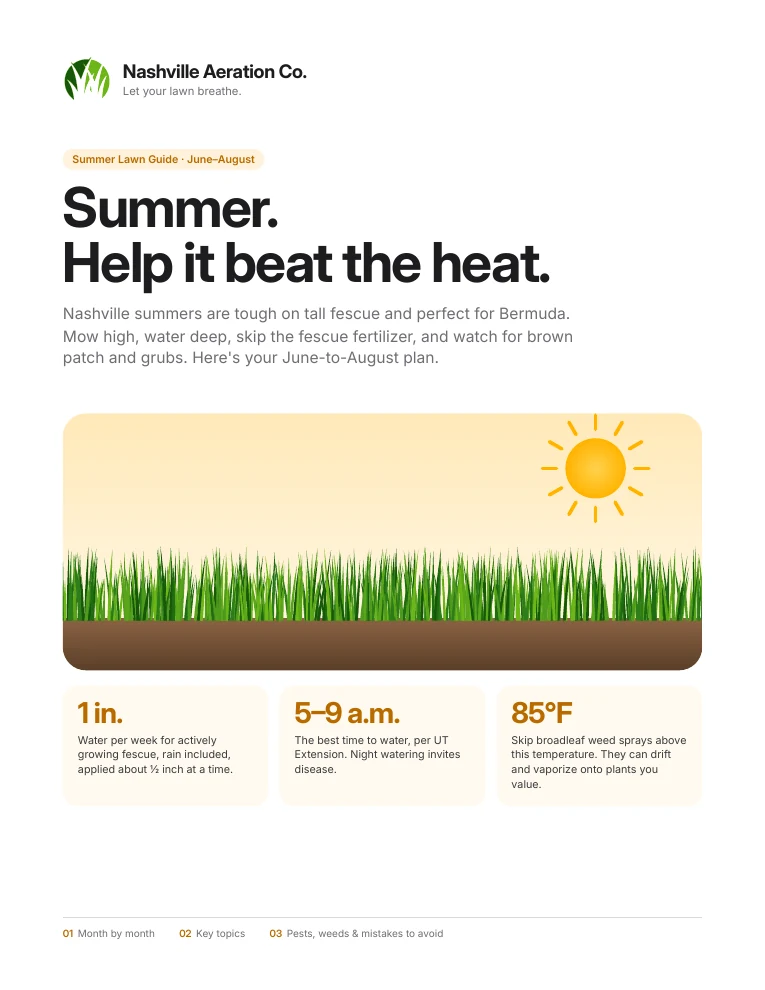 Open PDF
Part 01
Tall fescue needs protection, not a growth push
Raise the mower, keep the blade sharp, and avoid summer nitrogen. Heat-stressed fescue is vulnerable to traffic, disease, drought, and chemical injury.
Water early enough for foliage to dry, use measured deep applications rather than automatic daily sprinkling, and split cycles when Nashville clay begins to shed water as runoff.
Part 02
Bermuda and zoysia are in their working season
Warm-season turf grows and recovers rapidly in early summer. Late May through early July is the appropriate core-aeration window, and that is also the time to address excess thatch when the lawn truly needs it.
Feed according to grass type and actual need. Bermuda and zoysia do not share the same annual nitrogen allowance, even though both are warm-season lawns.
Part 03
Scout before a small problem spreads
Warm, humid nights favor brown patch in fescue. Mid-to-late summer also brings grub checks, nutsedge growth, and fall armyworm risk. Correct identification matters before treatment.
August is also planning time: send a soil test, reserve fall aeration and seeding for fescue, and avoid a weed preventer anywhere you intend to establish seed.
Download the free PDF.
The PDF includes the full calendar, checklists, tables, and reference notes in a format that is easy to save or print.
Common questions
A few answers before you download.
Should tall fescue be fertilized in summer?
Generally no. Summer nitrogen can increase stress and brown patch pressure. Save the main feeding program for fall.
When is the best time to aerate Bermuda in Nashville?
Late May through early July, while Bermuda is actively growing and can recover quickly.
How can I tell whether my lawn needs water?
Look for a bluish-gray cast, folded leaves, and footprints that remain visible. Measure irrigation output instead of relying only on run time.